RESEARCH INSTRUMENT

A portable blinding instrument for cannabis research.

NFC-enabled protocol. Within-subject study designs. Free for pilot studies.

2% of cannabis trials report blinding assessments — the field's most persistent methodological gap.
0 standardised instruments existed for blinding participants to cannabis type in within-subject designs.
1 portable, validated-in-consumer-trials instrument available for researcher collaboration today.

01 — The Problem

Cannabis research cannot currently achieve double-blind conditions.

Reliable blinding — the methodological cornerstone of any RCT — is largely absent from cannabis research. Participants in most cannabis trials know which condition they are in from taste, smell, and subjective effect.

The National Academies of Sciences (2017) identified cannabis blinding as a priority methodological gap. A systematic analysis of the CANNA-TICS trial literature (Frontiers in Neuroscience, 2022) found blinding assessments in fewer than 2% of published studies.

In within-subject crossover designs — where participant expectancy is the primary confound — the absence of a standardised blinding instrument makes it impossible to distinguish pharmacological from expectancy-driven effects.

Wilsey et al. (2016). Low-dose vaporized cannabis significantly improves neuropathic pain. Journal of Pain.
National Academies of Sciences, Engineering, and Medicine (2017). The Health Effects of Cannabis and Cannabinoids.
CANNA-TICS investigators (2022). Frontiers in Neuroscience.

"Only 2% of cannabis trials report blinding assessments. The National Academies of Sciences identifies cannabis blinding as a priority methodological gap. No standardised instrument exists for blinding participants to cannabis type in within-subject study designs."

02 — The Instrument

Two NFC-enabled tubes. One app. A complete session protocol.

Blindfold is a self-contained blinding instrument: two machined identical-looking tubes, an NFC read/write protocol, and an iOS/Android app that holds the allocation key while the participant does not.

01
Load subjects Insert cannabis samples — identical format required (pre-roll or flower in tube). One tube per condition.
02
Register allocation Researcher scans each tube via NFC. The app records condition assignment. The participant is not present for this step.
03
Blind the trial Tubes are shuffled in the opaque pouch. Externally, they are visually and tactilely identical. Participant cannot determine allocation from physical inspection.
04
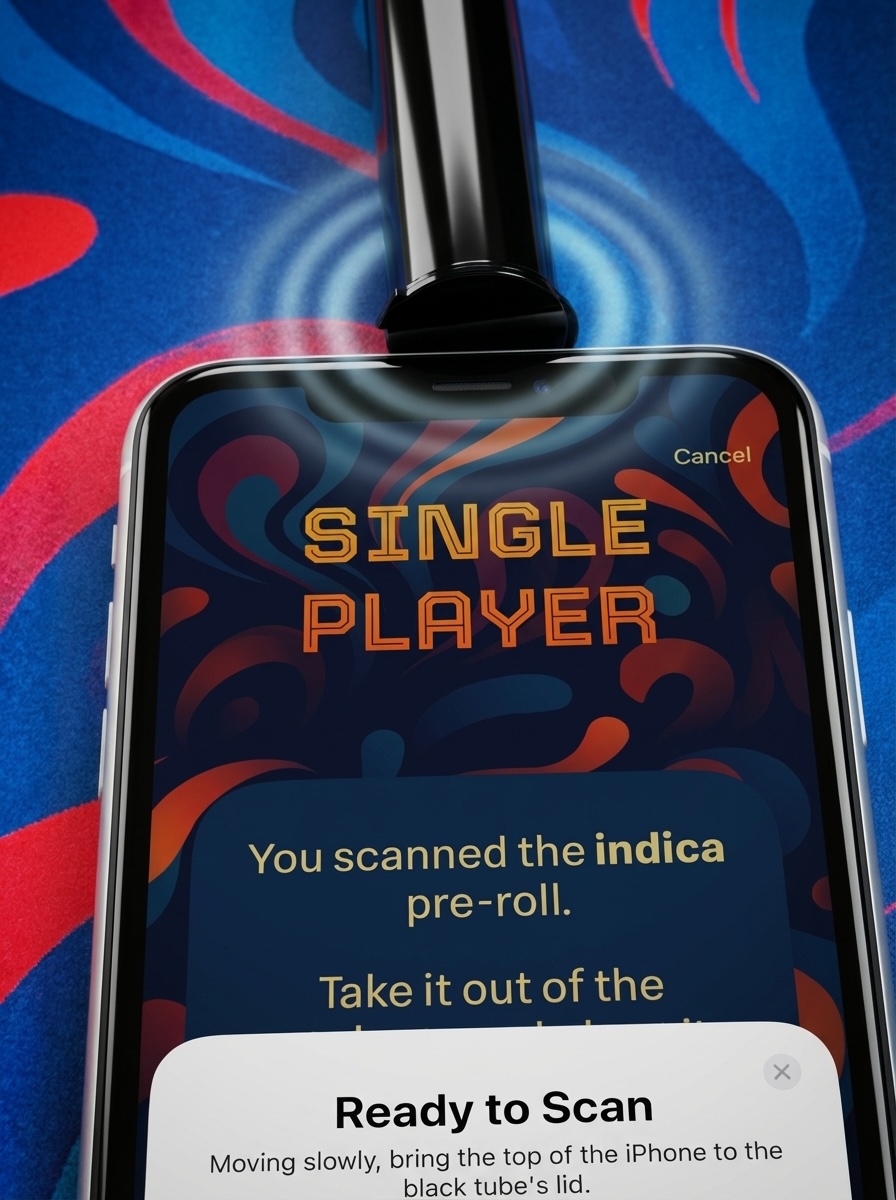
Session administration Participant scans a tube with the app. The app confirms it is registered but does not reveal the condition. Participant consumes and reports.
05
Reveal and log After the participant's guess and outcome report, the app reveals condition assignment. Session data is logged with timestamp, allocation, and participant response.
Blindfold NFC kit — two identical tubes NFC tube scanning with Blindfold app

03 — Study Designs Enabled

Five study designs now within reach.

01 Within-subject crossover trials Participant serves as own control across cannabis conditions. Blinding prevents condition-specific expectancy from confounding within-subject effect comparisons.
02 Expectancy-controlled designs Isolate pharmacological effects from expectancy effects by holding subjective belief constant. Enables 2×2 factorial designs (told/not told × active/control condition).
03 Chemotype perception studies Test whether participants can reliably distinguish cannabis chemotypes (indica/sativa, high-THC/high-CBD) by subjective effect alone — with measurable accuracy and blinding integrity.
04 Clinical indication RCTs Pain, anxiety, sleep, and appetite-related cannabis RCTs where participant unblinding is a known threat to validity. Instrument adds a blinding assessment measure at no additional cost.
05 Dose-response and route comparison studies Where identical administration route and format are required. The tube format enforces identical handling, removing a common source of demand characteristics in cannabis dose-response work.

04 — Current Limitations

What this instrument cannot yet do.

Disclosed here so you can assess fit for your study design without wasted back-and-forth.

SCOPE

Combustion and vapourisation only. The tube format is designed for pre-roll or loose flower. Edible, tincture, or topical administration is outside the current instrument scope.

SAMPLE

Identical sample format required. Both conditions must be the same format and weight in the tube. Mixed-format comparisons (e.g. flower vs. concentrate) cannot currently be blinded with this instrument.

OLFACTORY

Smell-based unblinding is not addressed. The tube caps reduce but do not eliminate pre-session olfactory cues. Highly trained cannabis users may be able to identify condition from smell before consumption.

EVIDENCE

Not yet peer-reviewed. Blinding integrity data comes from our consumer trial population (n≈200 sessions). No published academic validation exists. Pilot collaboration is the mechanism for generating that evidence.

DATA

App data is session-level, not clinical-grade. The app logs session events with timestamps. Integration with REDCap, eCRF, or study-specific data pipelines requires custom export — available on request.

05 — Collaboration

Free for pilot studies. Data stays with your group.

The goal is to get this instrument into research designs where it generates publishable blinding integrity data. There is no licensing fee, no royalty, and no claim on your study's results.

KIT ACCESS Hardware at no cost Tube kits — including NFC hardware — are provided free for pilot studies. We absorb the cost to build a validation dataset.
APP ACCESS Full app access iOS and Android app access, including data export. Custom session flows or additional logging fields are available for study-specific requirements.
DATA Data stays with you Your study data belongs to your research group. We only ask to be informed of any publications where the instrument is used so we can cite the validation evidence.
AUTHORSHIP Co-authorship on instrument papers If the publication specifically validates or evaluates the blinding instrument, co-authorship is appropriate and appreciated — not required for applied studies.
DESIGN Study design support We can contribute to protocol design for the blinding component. Not a substitute for a biostatistician, but useful for instrument-specific procedural questions.
TIMELINE Kits available immediately Hardware is in stock. App is live on iOS and Android. Lead time from agreement to first kit delivery is under one week for Canadian institutions.

06 — Get in Touch

If your study needs a blinding instrument, let's talk.

Email directly — no form, no sales process. Describe your study design and what you need. If there's fit, we can have kits to you in days.

Blindfold is built by Riddim Software Inc., Toronto.
Research enquiries: blindfold@riddimsoftware.com · Subject: "Blindfold research collaboration"